Introducing SocialCrank

“I’ve been waiting for you, Obi-Wan. We meet again, at last. The circle is now complete. When I left you I was but the learner, but now I am the master.”
TL;DR: SocialCrank is announced today. You can request early access here: SocialCrank.ai
Origins
In 2014, Michael and I left our jobs at Dwolla and launched SocialRank.
A few years earlier, we had some success with a viral hack called MVF. That experience got us fascinated with social followings and what they could tell you about people.
We believed that who you chose to follow on social media was one of the purest interest graphs you could find online. People can say anything they want, but actions are different. If you want to know what someone actually cares about, look at what they do.
Who do they follow? What do they pay attention to?
When we were building the original SocialRank, we kept coming back to one simple question: Why would you follow something you have no interest in?
That was the idea behind SocialRank. Your followers weren’t just a number. They were a database of real people, each giving you signals about who they were and what they cared about.
It turned out a lot of people were just as fascinated by this as we were.
SocialRank took off quickly and became one of the most popular audience tools for Twitter, and later Instagram. Brands, celebrities, creators, nonprofits, and others used it to understand and search through their audiences.
The NFL, Netflix, Samsung, the NBA, VaynerMedia, Sony Music, L’Oréal, and many others became customers.
We loved working on SocialRank because it solved a real problem. People had built these massive audiences, but had very few tools to actually understand who was in them and make those audiences useful.
Platform Dependency
Unfortunately, SocialRank had one major weakness that was very hard to overcome: we were completely dependent on the platforms.
To power the product, we relied on APIs from Twitter, Instagram, and other social networks. That meant the data SocialRank needed was ultimately controlled by someone else, and the rules around what we could access could change at any time.
That risk was always in the back of our minds. Then, in 2018, it became very real.

Instagram significantly rolled back its API and, almost overnight, cut off access to much of the data that products like SocialRank depended on. We could no longer get what we needed through the proper channels.
It created an immediate headache, but it also made something bigger very clear: there was a ceiling on what SocialRank could become as long as the platforms controlled access to the underlying data.
We could build a great product, attract great customers, and keep growing, but at any moment the rules could change underneath us.
That reality ultimately played a major role in our decision to sell SocialRank in 2019.
Fast-forward seven years. The company that acquired SocialRank eventually wound it down, and the product has now been dormant for the past few years.
A New Hope
A few months ago, I was working on a fun little game and getting ready to launch it.
As I started thinking about go-to-market, I remembered how much I loved using SocialRank to find people in my audience who were actually interested in whatever I was launching.
And I had a very simple thought: I wish I still had that tool.

Around the same time, I saw that X was bringing back broader API access with a pay-as-you-go model. I opened up the docs and started digging in.
Pretty quickly, I realized I could rebuild the spirit of the original SocialRank, at least for myself, and use it to help launch the game.
So I did.
Over the next week, I built a rough version and showed it to a friend who had used SocialRank back in the day.
Their response was immediate: Can I get access to this?
I said sure, why not.
Then came the next question: What about Instagram? What about the other platforms?
That sent me down the rabbit hole.
I started digging into what had changed over the past seven years, what was now possible, and how far we could actually take this.
And what I found got me very excited.
The Commoditization Of Web Data
As I started digging, I realized something had fundamentally changed over the last three to five years.
The web data ecosystem had exploded.
There were now tens, if not hundreds, of companies providing dependable access to social and web data. Things that were incredibly difficult, expensive, or completely dependent on a platform’s API a decade ago had become much easier to access.
The single biggest problem we had with SocialRank suddenly looked a lot less like a problem.
That alone was exciting.
But there was another massive change since the last time we built this: AI.
When we built SocialRank, the hard part was getting the data and then building every interface, filter, and workflow someone might want on top of it.
Today, language models completely change that equation.
Around that time, I showed what I was building to one of our investors. He immediately pushed me to think much bigger about what this could become.
He also happened to be an investor in Clay.com, the $7B NYC startup, and told me that what I was building reminded him of a social version of Clay.
That comparison stuck with me.
Clay had taken a huge universe of fragmented business data and made it incredibly useful by bringing it together in one place and giving people powerful ways to search, enrich, and act on it.
What if we could do something similar for social data?
Then he told me to spend time digging into MCP servers, AI connectors, and the way language models could interact directly with outside tools and data.
That was the moment the idea really expanded.

Instead of SocialRank being another dashboard where you log in, click filters, and search through followers, what if your social graph became something an AI could actually understand and work with?
You could ask questions in plain English.
“Find me all of my followers who are developers in New York.”
“Who follows us that talks about Solana?”
“Find the best 100 people in this audience to invite to an event.”
“Who in this audience should I reach out to about this product?”
The combination suddenly felt much bigger than rebuilding SocialRank.
The data had become accessible. AI had become capable of understanding it. And connectors gave language models a way to actually use it.
That changed everything.
SocialRank → SocialCrank
The original SocialRank was basically a dashboard.
We had to guess what people might want to know about their audience, build filters for those things, and then teach people how to use them.
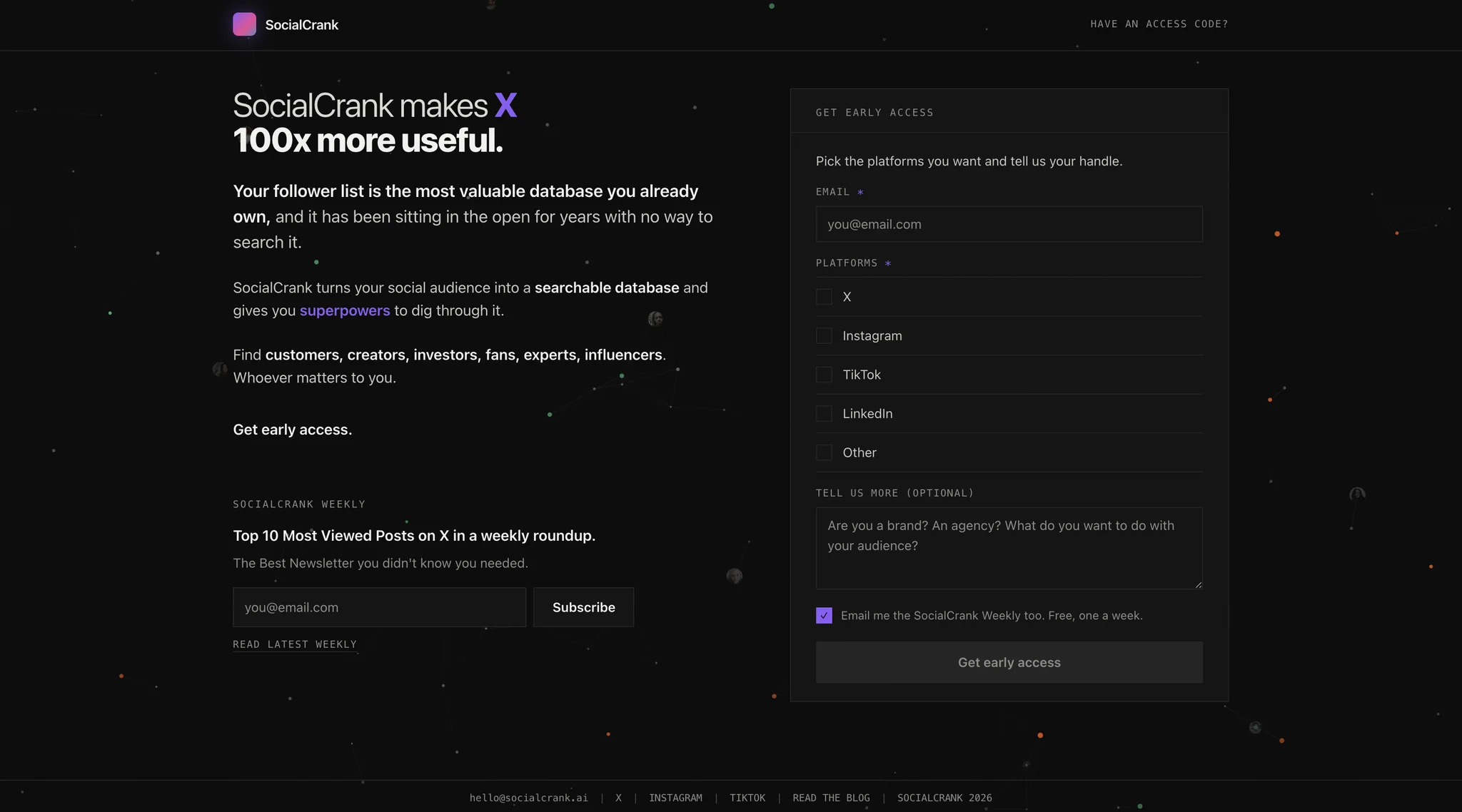
SocialCrank works very differently.
Now you can just ask for what you want.
“Find me the founders in Miami who follow Goblintown.”
“Show me the people following my company who work at Fortune 500 companies.”
“Find my followers who are into crypto, live in New York, and have more than 10,000 followers.”
The interface becomes language.
That sounds simple, but it is a pretty profound change.
We no longer have to anticipate every possible way someone might want to search an audience and build a button or filter for it. People can describe what they are looking for in plain English, and AI can help figure out how to get them there.
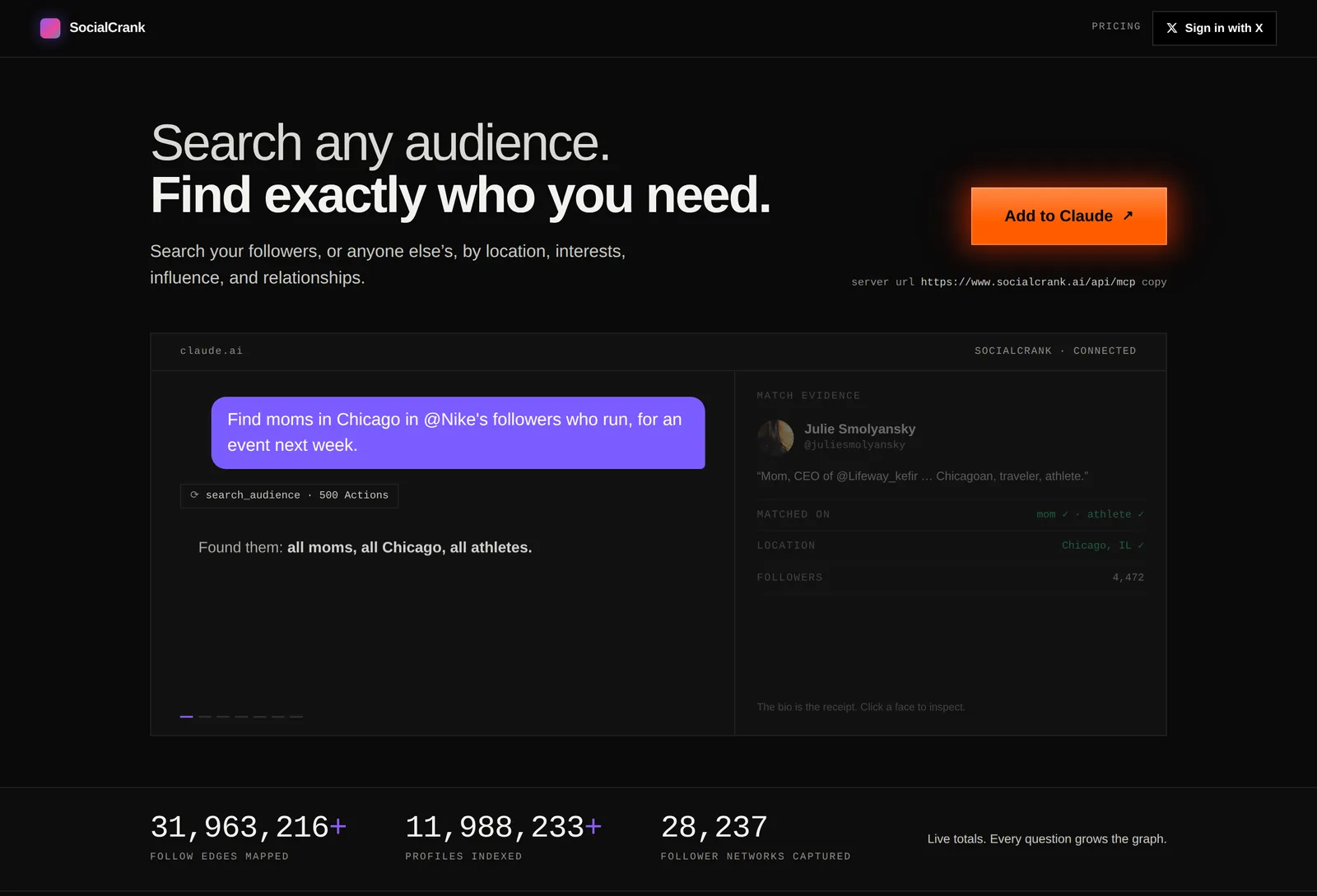
And with connectors, SocialCrank does not even have to be somewhere you go.
Your social data can become another layer that ChatGPT, Claude, or whatever AI you already use can access and work with.
That is a huge change for adoption.
You do not need to learn a new piece of software, understand complicated filters, or even remember to log into another dashboard.
You just ask a question.
But I think the bigger change is what the underlying data becomes.
A follower list stops being a list of names.
It becomes something you can ask questions of. Something you can combine with other data. Something your AI can use when helping you with sales, marketing, recruiting, events, community, research, or whatever other workflows people come up with.
Instead of SocialCrank only being a tool you log into, it can become the social data layer underneath the tools and AI people are already using every day.
That is a much bigger opportunity than the one we were chasing the first time around.
So I decided to go for it.
And, in a way, we have come full circle.
For more than a decade, I have been obsessed with the same basic problem:
How do you make sense of the audience you already have on social media and make it useful?
SocialRank was our first attempt at answering that question.
SocialCrank is what that idea looks like today.
What That Looks Like
Here is a real example.
I asked SocialCrank, in plain English:
“Find me the founders in Miami who follow @goblintown on X so I can invite them to a dinner at Art Basel.”
It started with 113,034 Goblintown followers.
317 are in Miami.
42 describe themselves as founders.
And 26 of those also follow me, @ajt, which means the invite does not even have to be completely cold.
That is a list of more than 100,000 people narrowed down to 26 highly relevant people in about a second.
And the crazy part is that none of this information is new.
That audience has been sitting out in the open for years.
Nobody had to tag those people.
Nobody had to enter them into a CRM.
Nobody had to fill out a form saying they were interested in Goblintown.
They already told us.
Every follow is a signal. Where someone lives, what they do, who they follow, what they talk about, and how they connect to you can all add context to that signal.
The problem was never that the data did not exist.
The problem was that there was no easy way to read all of those signals at once.
Back, With Bigger Aspirations And No Ceiling
Seven years after selling SocialRank, we are back.
This time with a new name, SocialCrank, which started as a joke and somehow stuck, and a much bigger vision for what this can become.
We are rebuilding the entire thing from the ground up.
But we are not just rebuilding the old SocialRank.
The world around it has changed too much.
The data is more accessible. AI has completely changed how people can interact with it. And connectors mean SocialCrank can live inside the tools people already use instead of forcing everyone into another dashboard.
Most importantly, we are no longer building a business where one platform can flip a switch and take the entire thing away.
We are starting with X, which launches soon.
Instagram and TikTok are next. LinkedIn is firmly on the roadmap, with YouTube and Substack high on my personal wish list after that.
Today, we are announcing that SocialCrank exists and that it is coming very soon.
X is basically ready, and over the next few weeks we are going to work closely with a small group of launch partners before opening things up more broadly.
If you are interested in being one of them, reach out.
A Final Note
It is rare that you get to come back to a problem you loved working on more than a decade later.
Even rarer to come back when the technology has changed enough that you can finally build the version you always wished existed.
That is what SocialCrank feels like to me.
Same obsession.
Much better tools.
Much bigger aspirations.
The circle is complete.
Now we get to see how far we can take it.
SocialCrank makes your social audience 100x more useful.
Request early access